Machine learning algorithms are the driving force behind modern artificial intelligence (AI). They enable computers to learn from data, identify patterns, and make decisions with minimal human intervention. From recommendation systems on streaming platforms to fraud detection in banking, Machine Learning Algorithms are transforming industries worldwide. Understanding these algorithms is essential for businesses and professionals looking to leverage data-driven technologies.
What Are Machine Learning Algorithms?
Machine Learning Algorithms are mathematical models designed to analyze data, learn from it, and improve their performance over time. Instead of following explicitly programmed instructions, these algorithms identify patterns and relationships within datasets. As additional information becomes available, their forecasts and judgments get more accurate.
The primary goal of machine learning is to automate analytical model building, allowing systems to adapt and improve without constant human guidance.
Types of Machine Learning Algorithms
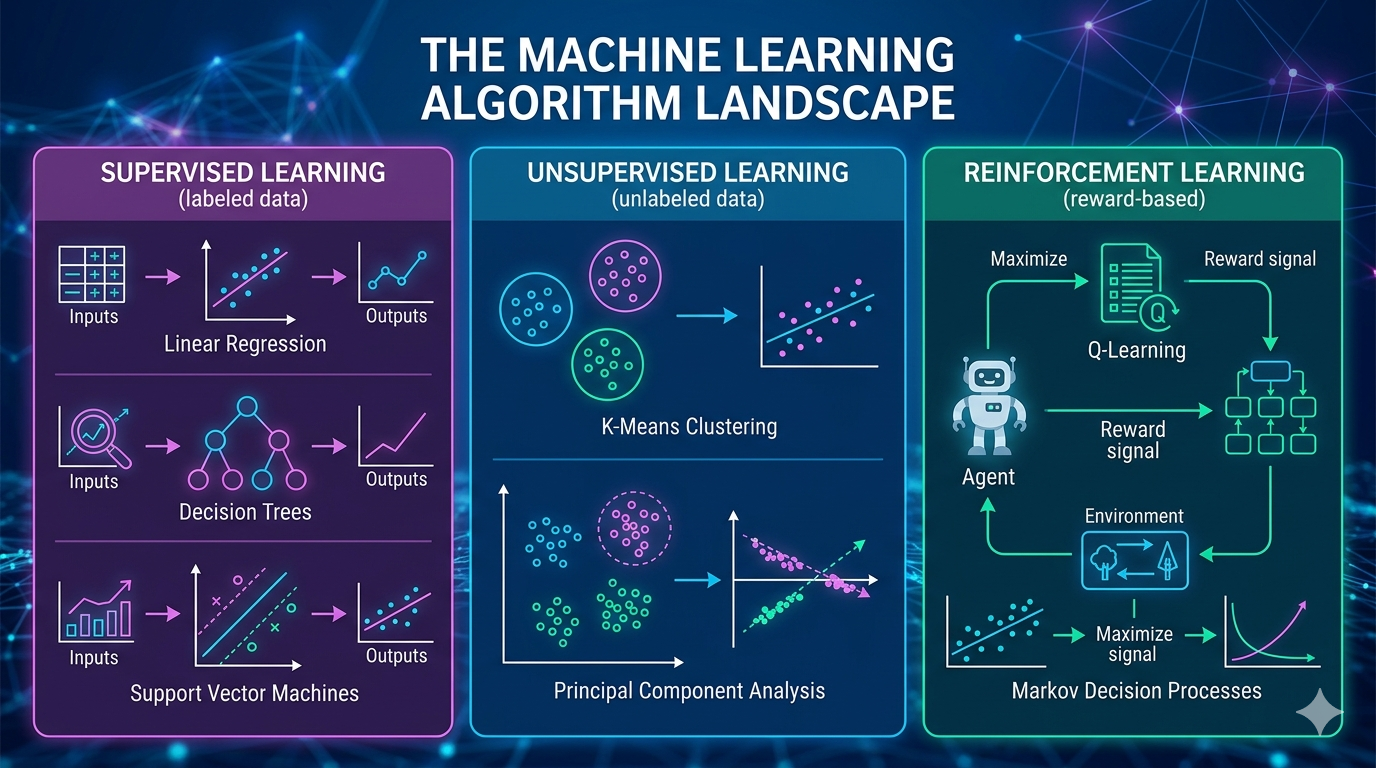
Machine learning algorithms are generally classified into three main categories:
1. Supervised Learning Algorithms
Training models with labeled data is done via supervised learning. The method learns from input-output pairs and foresees results for fresh data.
Common supervised learning algorithms include:
- Linear Regression
- Logistic Regression
- Decision Trees
- Random Forest
- Support Vector Machines (SVM)
These algorithms are widely used for tasks such as sales forecasting, customer segmentation, and spam email detection.
2. Unsupervised Learning Algorithms
Unsupervised learning works with unlabeled data. The algorithm identifies hidden patterns, structures, or relationships without predefined outcomes.
Popular unsupervised learning algorithms include:
- K-Means Clustering
- Hierarchical Clustering
- Principal Component Analysis (PCA)
- Association Rule Learning
Businesses often use these algorithms for customer behavior analysis, market research, and anomaly detection.
3. Reinforcement Learning Algorithms
Teaching agents using rewards and penalties is the main goal of reinforcement learning. The algorithm learns the best actions by interacting with an environment and maximizing cumulative rewards.
Applications of reinforcement learning include:
- Robotics
- Autonomous vehicles
- Game-playing AI
- Resource management systems
This approach is particularly effective in dynamic environments where continuous decision-making is required.

Popular Machine Learning Algorithms Explained
Decision Trees
Decision Trees use a tree-like structure to make decisions based on specific conditions. They are easy to understand, interpret, and implement, making them popular for classification and prediction tasks.
Random Forest
To increase accuracy and minimize overfitting, Random Forest mixes a number of decision trees. It is highly effective for handling large datasets and complex prediction problems.
Support Vector Machines (SVM)
SVM algorithms identify the optimal boundary that separates different classes of data. They are commonly used in image recognition, text classification, and bioinformatics.
K-Means Clustering
K-Means is a clustering algorithm that groups similar data points into clusters. It is frequently used in customer segmentation, recommendation systems, and market analysis.
Neural Networks
Neural networks are inspired by the structure of the human brain. They form the foundation of deep learning and are capable of solving complex tasks such as speech recognition, image processing, and natural language understanding.
Benefits of Machine Learning Algorithms
Machine learning algorithms provide numerous advantages, including:
- Improved decision-making through data analysis
- Automation of repetitive tasks
- Enhanced customer experiences
- Faster and more accurate predictions
- Scalability across large datasets
Organizations can use these benefits to increase efficiency, reduce operational costs, and gain a competitive advantage.
Future of Machine Learning Algorithms
As technology continues to evolve, machine learning algorithms are becoming more sophisticated and accessible. Advances in cloud computing, big data, and artificial intelligence are accelerating their adoption across industries. Future developments are expected to improve model accuracy, interpretability, and real-time decision-making capabilities.
Businesses that invest in machine learning today will be better positioned to innovate, optimize operations, and meet the demands of an increasingly digital world.
In contemporary AI systems, machine learning algorithms are crucial because they let computers learn from data and make wise judgments. Whether through supervised learning, unsupervised learning, or reinforcement learning, these algorithms are revolutionizing industries and creating new opportunities for innovation. Understanding the fundamentals of machine learning algorithms is the first step toward harnessing the power of artificial intelligence in today’s data-driven environment.
Effects of AI in Upcoming Technology
Manhole – Essential Access Points in Urban Infrastructure
Read Also : Social Network Website Design