
Content marketing is changing rapidly as artificial intelligence becomes a regular part of the creative process. AI tools can research topics, generate drafts, analyze trends, and produce content in seconds. However, speed alone does not guarantee valuable content. This is where a Human-in-the-Loop Content Strategy becomes important.
A human-in-the-loop approach combines the efficiency of artificial intelligence with human creativity, experience, judgment, and editorial oversight. Instead of allowing AI to control the entire content process, businesses use AI as an assistant while people remain responsible for important decisions.
What Is Human-in-the-Loop Content Strategy?
A Human-in-the-Loop Content Strategy is a content creation framework where humans actively participate in AI-assisted research, writing, editing, optimization, and publishing.
AI can handle repetitive and time-consuming activities, while human professionals provide direction and quality control. For example, an AI system may suggest article ideas or create an initial outline, but a content strategist decides whether the topic is relevant to the audience.
This approach creates a balance between automation and authenticity. It allows organizations to produce content efficiently without losing the human perspective that makes information useful and engaging.
Why Human Oversight Matters in AI Content
AI-generated content can be fast and grammatically correct, but it may sometimes lack originality, context, personal experience, or emotional understanding. It can also misunderstand an instruction or present inaccurate information confidently.
Human oversight helps identify these weaknesses before content reaches readers. Editors can verify facts, improve clarity, remove unnecessary information, and make sure the final article reflects the brand’s voice.
Human involvement is particularly important for content involving complex subjects, professional advice, statistics, or sensitive topics. A qualified person can recognize situations where additional research or expert review is necessary.
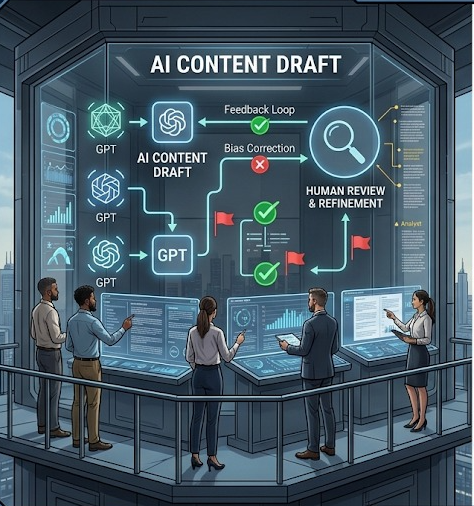
How to Build a Human-in-the-Loop Content Workflow
A successful workflow begins by clearly defining what AI should handle and what requires human judgment.
1. Start With Human Strategy
Before using AI, establish the content goal, target audience, search intent, tone, and desired outcome. Human strategists should determine what the audience actually needs rather than simply producing content around popular keywords.
2. Use AI for Research and Ideation
AI can help generate topic ideas, content briefs, questions, outlines, and keyword variations. These suggestions can save valuable time, but humans should evaluate them before they become part of the content plan.
3. Create an AI-Assisted Draft
Once the strategy is approved, AI can help produce a preliminary draft. Writers can then use this material as a starting point instead of treating it as the final version.
4. Add Human Expertise
This is a crucial phase. Writers and subject-matter experts can add examples, opinions, practical experiences, original insights, and relevant context. These elements make content more distinctive and useful.
5. Edit, Verify, and Optimize
Human editors should check facts, sources, grammar, readability, brand consistency, and search intent. SEO specialists can also review headings, internal linking opportunities, keyword placement, metadata, and overall content structure.
Benefits of a Human-in-the-Loop Approach
A Human-in-the-Loop Content Strategy offers several advantages. It can increase content production speed while maintaining editorial standards. Businesses can also reduce repetitive workloads, allowing writers to spend more time on strategy and creative development.
Another major benefit is improved content quality. Human reviewers can identify misleading statements, repetitive language, weak arguments, and irrelevant information that automated systems may overlook.
The approach can also strengthen brand identity. Human editors ensure that AI-assisted content sounds consistent with the organization’s communication style rather than appearing generic.
Human Creativity and AI Efficiency
The goal is not to choose between humans and AI. Instead, effective content teams use both strategically.
AI is excellent at processing large amounts of information and assisting with repetitive tasks. Humans are better at understanding context, emotion, originality, ethics, and audience expectations.
When these strengths are combined, businesses can develop a more efficient and reliable content operation.
The Future of AI-Assisted Content Marketing
As AI technology continues to develop, human involvement will remain valuable. Search engines and audiences increasingly expect content that demonstrates usefulness, credibility, originality, and genuine expertise.
Organizations that build strong editorial processes around AI can benefit from automation without sacrificing quality. The most successful strategy will likely be one where AI accelerates production while humans remain responsible for creativity, accuracy, and meaningful communication.
A Content Strategy that involves Human-in-the-Loop offers a tangible approach to integrating artificial intelligence with human knowledge. AI can accelerate research, brainstorming, drafting, and optimization, while human professionals provide the judgment needed to create trustworthy and engaging content.
Rather than replacing content creators, AI works best as a powerful supporting tool. Businesses that maintain meaningful human oversight can produce content faster while preserving originality, accuracy, brand personality, and audience value. This balanced approach can become an important foundation for modern content marketing.
Effects of AI in Upcoming Technology
Manhole – Essential Access Points in Urban Infrastructure
RCPC Manhole Covers and Frames
Read Also : Social Network Website Design