Workflow automation is changing how businesses manage repetitive tasks, organize information, and improve productivity. While traditional automation tools rely heavily on fixed rules, micro-agents for workflow automation offer a more flexible approach. These small AI-powered agents can handle specific tasks, make decisions based on context, and work together as part of a larger automated process.
From customer support and data management to marketing and software development, micro-agents are becoming useful for organizations that want intelligent automation without building complicated AI systems from scratch.
What Are Micro-Agents?
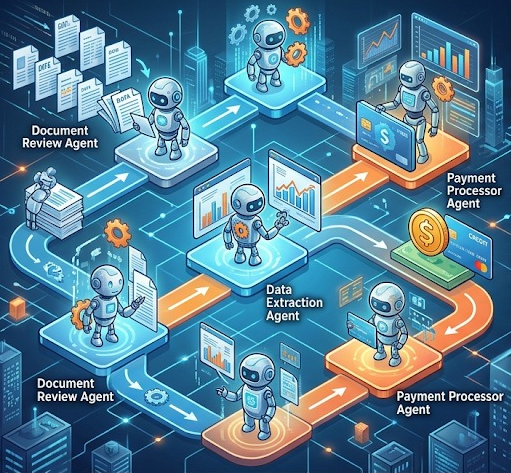
Micro-agents are specialized AI agents designed to perform a particular task or a small group of related tasks. Instead of asking one large AI system to manage an entire workflow, businesses can assign individual responsibilities to different agents.
For example, one micro-agent can read incoming emails, another can classify the requests, and a third can update information in a CRM. This modular approach makes automation easier to manage, test, and improve.
The biggest advantage is specialization. Each micro-agent can focus on one responsibility instead of trying to understand an entire business operation.
Why Use Micro-Agents for Workflow Automation?
The growing interest in AI workflow automation comes from the need to reduce repetitive manual work. Micro-agents can help businesses automate processes while keeping humans involved when important decisions require oversight.
Some major benefits include:
- Reduced repetitive work: Agents can handle routine digital tasks automatically.
- Faster workflows: Automated processes can operate continuously without waiting for manual intervention.
- Better scalability: New agents can be added as business requirements change.
- Improved consistency: Repetitive tasks can follow predefined instructions more reliably.
- Flexible decision-making: AI agents can evaluate information and select appropriate actions.
- Modular architecture: Individual agents can be modified without rebuilding the complete workflow.

Best Micro-Agent Use Cases
Micro-agents can be applied to many business processes. In customer service, an agent can categorize incoming messages and direct them to the correct department. In marketing, specialized agents can research topics, prepare content ideas, analyze campaigns, and summarize performance.
Finance teams can use agents to organize invoices, identify missing information, and prepare reports. Human resources departments can automate employee onboarding tasks, document collection, and routine communication.
Developers can also use micro-agents for code review, testing, documentation, and issue classification. Because each agent performs a focused task, organizations can gradually introduce automation rather than changing their entire workflow at once.
Popular Platforms for Building Micro-Agent Workflows
Several AI and automation platforms can be used to create agent-based workflows. Tools such as Microsoft Copilot Studio, Zapier, Make, LangChain, CrewAI, and AutoGen provide different approaches to connecting AI models with business processes and applications.
The best platform depends on the workflow. No-code platforms may be suitable for business teams that want quick automation, while developer-focused frameworks can provide greater control over complex agent architectures.
When selecting a platform, businesses should consider integrations, security, scalability, monitoring, customization, and overall operating costs.
How to Choose the Best Micro-Agents
Choosing the right micro-agents starts with identifying repetitive processes that consume significant employee time. A good candidate should have clear inputs, predictable objectives, and measurable results.
It is also important to define what an agent is allowed to do. Sensitive actions should include approval steps, logging, and human oversight. Businesses should regularly monitor agent performance and update instructions when workflows change.
The Future of Workflow Automation
Micro-agents are likely to become an important part of intelligent business automation. Instead of replacing entire workflows with a single AI system, companies can build networks of smaller agents that cooperate to complete complex processes.
As AI technology develops, these agents will become better at understanding context, using business applications, and coordinating with other automated systems. This could make workflow automation more adaptive, efficient, and accessible for businesses of different sizes.
The best micro-agents for workflow automation are not necessarily the most complicated ones. The most effective agents are those designed around specific business needs and connected to practical workflows. By combining specialized AI agents with automation platforms, companies can reduce repetitive work, improve efficiency, and create smarter digital operations.
A gradual, well-monitored approach allows organizations to benefit from AI automation while maintaining control over important business decisions.
Effects of AI in Upcoming Technology
Manhole – Essential Access Points in Urban Infrastructure
RCPC Manhole Covers and Frames
Read Also : Social Network Website Design