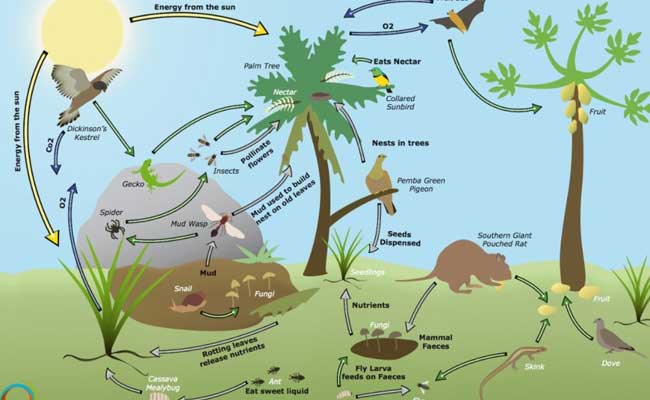
Climate change is often described as a gradual process, but scientists are increasingly studying another possibility: sudden and self-reinforcing changes within Earth’s natural systems. These events are known as climate tipping points. A tipping point occurs when a system passes a critical threshold and begins shifting toward a different state, sometimes with changes that are difficult or impossible to reverse on human timescales.
Scientists are closely monitoring several major parts of the planet to understand how close they may be to such thresholds. Their research is important because identifying warning signs could help governments and communities reduce risks before major environmental changes become irreversible.
What Are Climate Tipping Points?
A climate tipping point is not simply a day when temperatures suddenly rise. Instead, it describes a threshold in a complex Earth system. Once that threshold is crossed, internal feedback mechanisms can reinforce the change.
For example, melting ice reduces the amount of sunlight reflected back into space. Darker ocean or land surfaces absorb more solar energy, which can increase warming and cause additional melting. Similar feedbacks can occur in forests, oceans, permafrost and atmospheric circulation.
Ice Sheets Under Scientific Observation
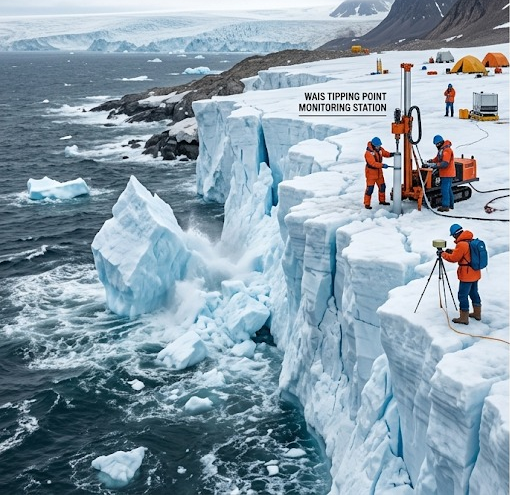
The Greenland and Antarctic ice sheets are among the most closely watched climate tipping elements. Rising temperatures can accelerate ice loss, while changes in ice structure and ocean conditions may further influence melting.
Scientists use satellite observations, field measurements and climate models to track ice thickness, surface melting, glacier movement and ocean temperatures. Major changes in these systems could eventually contribute to substantial sea-level rise, making coastal communities particularly vulnerable.
Amazon Rainforest and Forest Tipping Risks
The Amazon rainforest plays an important role in the global carbon cycle. Scientists are investigating whether increasing heat, drought, fires and deforestation could push parts of the forest toward a less resilient state.
The concern is that forest degradation can reduce rainfall and weaken the ecosystem’s ability to recover. Recent research highlights the Amazon as one of several tipping elements whose stability may be declining under continued human pressure.
Permafrost and the Carbon Feedback
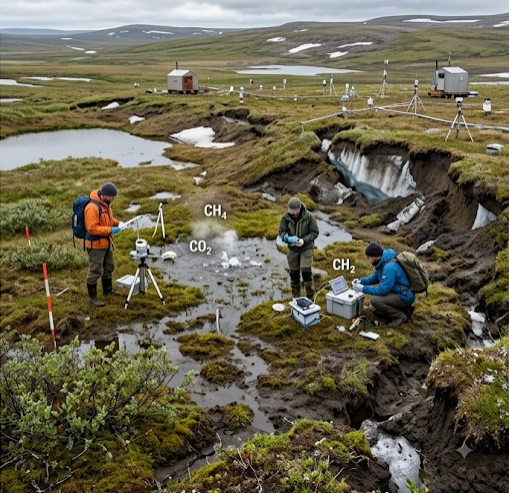
Permafrost contains large quantities of organic carbon that have remained frozen for long periods. As Arctic temperatures increase, some permafrost can thaw, allowing microorganisms to break down previously frozen organic matter and release greenhouse gases.
Scientists monitor ground temperatures, soil conditions, vegetation changes and greenhouse-gas emissions to understand this feedback. Because additional emissions could contribute to further warming, permafrost is an important part of climate tipping-point research.
Ocean Circulation and Coral Reefs
The oceans absorb enormous amounts of heat and influence weather and climate around the world. Scientists therefore monitor major circulation systems, including the Atlantic Meridional Overturning Circulation (AMOC), for changes that could indicate increasing instability.
Coral reefs are another major concern. Marine heatwaves and ocean warming can cause repeated bleaching, while acidification adds additional pressure. Researchers combine ocean observations, reef surveys and climate models to assess the resilience of these ecosystems.
How Scientists Detect Warning Signs
Predicting a tipping point is challenging because Earth systems are interconnected and thresholds are not known with perfect precision. Researchers therefore look for signals such as increasing variability, slower recovery after disturbances and changes in long-term trends.
New research is also exploring statistical indicators that could reveal whether an Earth system is becoming less stable. A 2026 study examined time irreversibility as a possible indicator for approaching critical transitions in Earth subsystems.
Why Monitoring Climate Tipping Points Matters
Scientists do not monitor tipping points simply to predict disasters. Their research can help policymakers understand risk and identify opportunities for prevention. The exact threshold for many tipping elements remains uncertain, but uncertainty does not mean the risk can be ignored.
Reducing greenhouse-gas emissions, protecting forests, limiting ecosystem destruction and improving climate monitoring can reduce pressure on vulnerable systems. The United Nations Scientific Advisory Board has emphasized that understanding interconnected tipping points is important for managing planetary risks.
Climate tipping points tracked by scientists represent some of the most important questions in modern Earth-system science. From melting ice sheets and thawing permafrost to changing forests, coral reefs and ocean circulation, researchers are examining how natural systems respond to increasing climate pressure.
Scientists cannot yet predict every tipping point with an exact date or temperature threshold. However, ongoing observations, computer models and early-warning research are improving our understanding. Protecting the planet therefore depends not only on responding to climate impacts but also on preventing vulnerable Earth systems from being pushed beyond dangerous thresholds.
Andaman and Nicobar Islands Forests
Read Also: Tours And Travels Website Design