Have you ever looked up on a clear day and wondered why the sky appears blue? This everyday phenomenon is actually rooted in fascinating physics and the way sunlight interacts with Earth’s atmosphere. Let’s break it down in a simple, SEO-friendly way so you can understand the science behind it.
What Is Sunlight Made Of?
Sunlight might look white to our eyes, but it is actually a mixture of different colors. These colors form a spectrum, commonly remembered as VIBGYOR—violet, indigo, blue, green, yellow, orange, and red. Each color has a different wavelength, with blue and violet having shorter wavelengths and red having a longer one.
The Role of Earth’s Atmosphere
When sunlight enters Earth’s atmosphere, it doesn’t travel straight to the ground. Instead, it interacts with tiny particles like air molecules, dust, and water vapor. This interaction causes the light to scatter in different directions.
This process is known as Rayleigh scattering, which explains why shorter wavelengths (like blue and violet) scatter more than longer wavelengths (like red and orange).
Why Blue and Not Violet?
You might be wondering: if violet light scatters even more than blue, why isn’t the sky violet?
There are two main reasons:
- Human Eye Sensitivity: Our eyes are more sensitive to blue light than violet.
- Absorption of Violet Light: Some of the violet light is absorbed by the upper atmosphere, leaving blue as the dominant color we see.
Why Does the Sky Change Color at Sunrise and Sunset?
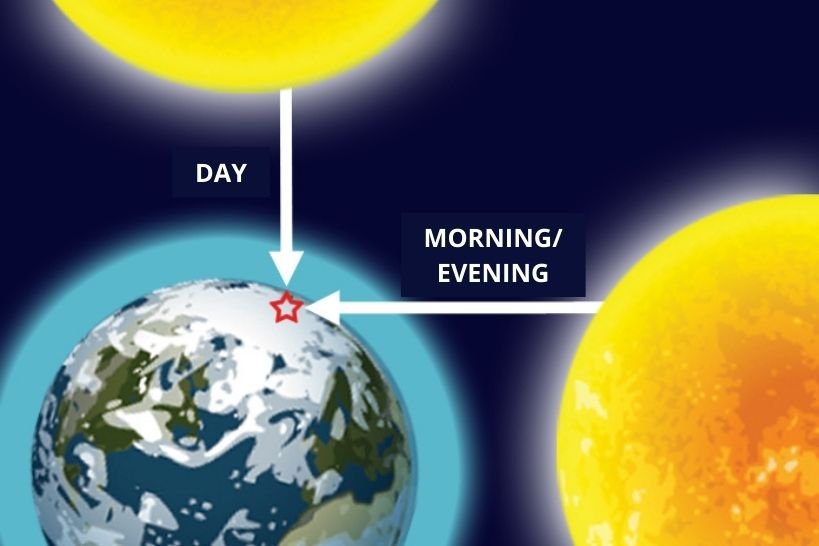
If the sky is blue because of scattering, then why does it turn red, orange, or pink during sunrise and sunset?
The answer lies in the angle of the sun. When the sun is low on the horizon, sunlight has to travel through a thicker layer of the atmosphere. This causes most of the shorter wavelengths (blue and violet) to scatter away before reaching your eyes.
What remains are the longer wavelengths—reds, oranges, and yellows—creating those beautiful sunrise and sunset colors.
What Happens on Cloudy or Polluted Days?
On cloudy days, the sky may appear gray or white instead of blue. This is because clouds are made up of larger water droplets, which scatter all colors of light equally. When all colors mix, the result is white or gray.
Similarly, pollution and dust particles in the air can affect the color of the sky. They can scatter light differently, sometimes making the sky look hazy or even giving it a reddish or yellowish tint.
Why Is the Sky Dark at Night?
At night, the sky appears dark because the sun is no longer illuminating the atmosphere from your location on Earth. Without sunlight, there is no scattering of light, so the sky turns black, allowing stars and planets to become visible.
Fun Facts About the Blue Sky
- Astronauts in space see a black sky even during the day because there is no atmosphere to scatter sunlight.
- On other planets, the sky can be different colors depending on their atmospheric composition.
- The deep blue color you see on a clear day indicates less pollution and cleaner air.
The reason the sky is blue comes down to the interaction between sunlight and Earth’s atmosphere. Through Rayleigh scattering, shorter wavelengths like blue light spread across the sky, making it appear blue to our eyes. Changes in the sun’s position, atmospheric conditions, and particles in the air all contribute to the different colors we observe throughout the day.
India’s Secret Beaches That Offer Peace and Serenity
Top Beaches in India for Solitude and Spiritual Freedom
Read More: Tours And Travels Website Design