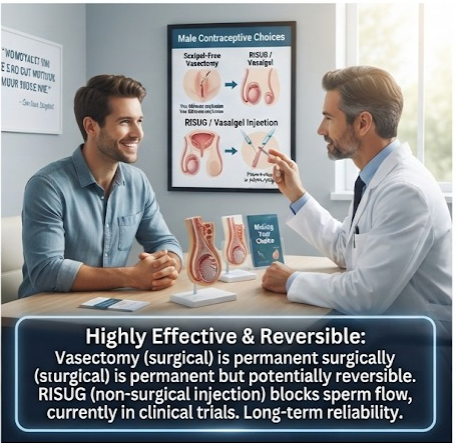
For decades, contraception has primarily focused on women, but recent advancements in male contraceptive options are changing the conversation. Scientists and healthcare researchers are actively developing safe, effective, and reversible birth control methods for men. These innovations aim to provide couples with more shared responsibility in family planning while expanding contraceptive choices beyond traditional methods.
In this article, we’ll explore the latest updates on male contraceptives, current options available, and what the future may hold.
Why Male Contraceptives Are Gaining Attention
Unplanned pregnancies remain a global public health concern. While women have multiple birth control options, men currently have very limited choices. As awareness about reproductive equality grows, there is increasing demand for reliable male contraceptives that are easy to use, reversible, and have minimal side effects.
Medical researchers believe expanding male birth control options could reduce unintended pregnancies and allow couples to make more balanced reproductive decisions.
Current Male Contraceptive Options
Although research continues, there are currently only a few widely available methods for men.
1. Condoms
Condoms remain the most accessible and commonly used male contraceptive. They are inexpensive, easy to purchase, and provide protection against both pregnancy and sexually transmitted infections (STIs).
When used correctly and consistently, condoms are highly effective. However, incorrect use can reduce their effectiveness.
2. Vasectomy
A vasectomy is a minor surgical procedure that blocks the tubes carrying sperm. It is regarded as one of the most efficient forms of birth control for men in the long run.
Although vasectomy reversal procedures exist, they are not always successful. Therefore, it is generally recommended for men who are certain they do not want biological children in the future.
Exciting Advances in Male Birth Control Research
Researchers worldwide are testing several innovative contraceptive methods that could become available in the coming years.
Hormonal Male Contraceptives
Hormonal contraceptives work by temporarily reducing sperm production without affecting long-term fertility. Scientists have developed hormone-based injections, gels, and pills that combine testosterone with other hormones to suppress sperm production.
Several clinical studies have shown encouraging results, although researchers continue to monitor long-term safety and possible side effects such as mood changes, acne, and weight fluctuations.
Non-Hormonal Male Contraceptives
Non-hormonal contraceptives are attracting significant attention because they aim to prevent pregnancy without altering hormone levels.
Researchers are studying medications that block sperm movement, interfere with sperm development, or temporarily prevent sperm from fertilizing an egg. Early research suggests these methods may offer effective contraception while minimizing hormone-related side effects.

Male Contraceptive Pills-A Promising Future
One of the most anticipated developments is the male contraceptive pill. Unlike traditional female birth control pills, these experimental medications target sperm production or sperm function without permanently affecting fertility.
Several early-stage clinical trials have demonstrated promising safety profiles, but more extensive testing is required before regulatory approval.
If successful, male contraceptive pills could become a convenient daily option similar to female oral contraceptives.
Reversible Contraceptive Gels and Injections
Scientists are also developing long-acting contraceptive injections and gels that can provide protection for weeks or even months.
Some injectable methods work by temporarily blocking the flow of sperm, while others reduce sperm production through hormone regulation. One of the major goals is to create methods that can be fully reversed after treatment is stopped.
These options may appeal to men seeking reliable contraception without daily medication.
Benefits of Expanding Male Contraceptive Choices
Increasing the number of male contraceptive options offers several important benefits:
- Encourages shared responsibility for family planning.
- Provides couples with greater flexibility.
- Helps reduce unintended pregnancies.
- Supports reproductive autonomy for men.
- May improve communication between partners about contraception.
As more options become available, healthcare providers can better tailor contraceptive recommendations to individual needs and preferences.
Challenges Still Facing Male Contraceptive Development
Despite remarkable progress, researchers continue to face several challenges. Any new contraceptive must demonstrate high effectiveness, excellent safety, reversibility, and minimal side effects before receiving approval.
Public acceptance is another important factor. Education and awareness will play a key role in helping people understand the safety and benefits of new male contraceptive technologies.
Regulatory approval also requires large-scale clinical trials, which can take several years to complete.
The future of male contraceptive options looks increasingly promising. While condoms and vasectomy remain the primary choices today, groundbreaking research into hormonal pills, non-hormonal medications, contraceptive gels, and reversible injections could dramatically expand men’s reproductive choices in the near future.
As scientific innovation continues, male contraception may soon become more convenient, effective, and accessible than ever before. These developments represent an important step toward shared responsibility in family planning, giving couples more control over their reproductive health and future decisions.
Liver Cancer Symptoms Cause and Remedy
Read Also: Medical Website Design