Understanding your fertility window is one of the most effective ways to improve your chances of conceiving naturally or to better understand your menstrual cycle. The fertility window refers to the days during each menstrual cycle when pregnancy is most likely to occur. By learning how to calculate your fertile days, you can make informed decisions about family planning and reproductive health.
In this guide, we’ll explain what a fertility window is, how to calculate it accurately, and the signs that indicate ovulation.
What Is a Fertility Window?
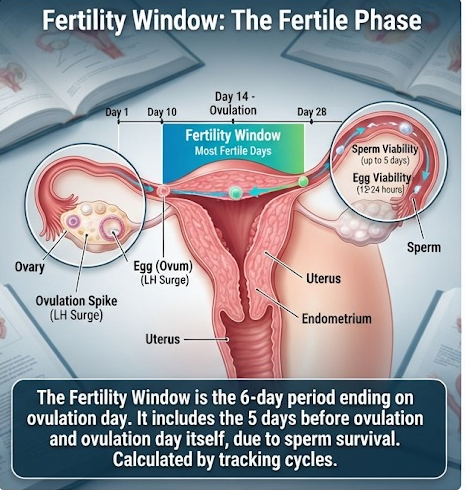
The fertility window is the period during a woman’s menstrual cycle when she has the highest chance of becoming pregnant. Since sperm can survive in the female reproductive tract for up to five days and an egg remains viable for only 12 to 24 hours after ovulation, the fertile window generally lasts about six days.
These six days include:
- The five days leading up to ovulation.
- The day of ovulation itself.
Having intercourse during this period significantly increases the likelihood of conception.
How the Menstrual Cycle Affects Fertility
An average menstrual cycle usually spans 28 days, but it is considered normal for women to have cycles that vary from 21 to 35 days. Ovulation usually occurs about 14 days before the start of the next menstrual period, not necessarily on day 14 of every cycle.
For example:
- A 28-day cycle typically ovulates around day 14.
- A 30-day cycle usually ovulates around day 16.
- Ovulation might occur approximately on day 18 of a 32-day cycle.
Knowing your average cycle length is the first step toward calculating your fertile days.
How to Calculate Your Fertility Window
Calculating your fertility window can be done with a few simple steps:
1. Track Your Menstrual Cycle
Record the first day of your period for several months. This helps determine your average cycle length and identify any variations.
2. Estimate Your Ovulation Day
Deduct 14 days from the length of your typical cycle.
For example:
- 28-day cycle: Ovulation around day 14.
- 30-day cycle: Ovulation around day 16.
- 35-day cycle: Ovulation around day 21.
3. Count Back Five Days
Since sperm can survive for several days, count back five days from your estimated ovulation date.
For a 28-day cycle:
- Fertility window: Days 9 to 14.
4. Include the Day After Ovulation
Because the egg may survive for up to 24 hours, some couples also include the day after ovulation when planning intercourse.
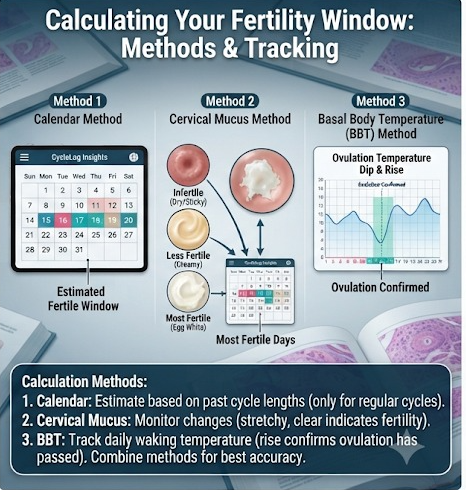
Signs That You Are Ovulating
Your body provides several natural signs that ovulation is approaching.
Clear Cervical Mucus
Cervical mucus becomes clear, slippery, and stretchy, resembling raw egg whites. This kind of mucus assists in aiding sperm to move more smoothly towards the egg.
Slight Rise in Basal Body Temperature
After ovulation, your basal body temperature increases slightly by about 0.3°C to 0.5°C. Tracking your temperature every morning can help identify ovulation over time.
Mild Pelvic Pain
Some women experience mild discomfort or cramping on one side of the lower abdomen during ovulation, known as mittelschmerz.
Increased Libido
A lot of women experience a spontaneous rise in sexual drive when in their fertile period because of hormonal shifts.
Tools That Help Track Fertility
Several methods can improve fertility tracking accuracy.
- Menstrual cycle tracking apps
- Ovulation predictor kits (OPKs)
- Basal body temperature charts
- Cervical mucus monitoring
- Fertility monitors
Using a variety of techniques frequently yields the most dependable outcomes.
Factors That Can Affect Your Fertility Window
Women do not all ovulate on a consistent day each month. Several factors can shift or delay ovulation, including:
- Stress
- Hormonal disorders
- Polycystic ovary syndrome (PCOS)
- Thyroid problems
- Certain medications
- Significant weight changes
- Excessive exercise
- Poor sleep patterns
If your cycles are highly irregular, consult a healthcare professional for personalized guidance.
Tips to Improve Your Chances of Conception
If you’re trying to become pregnant, consider these healthy habits:
- Maintain a balanced diet rich in fruits, vegetables, whole grains, and lean proteins.
- Exercise regularly without overtraining.
- Avoid smoking and excessive alcohol consumption.
- Maintain a healthy body weight.
- Take folic acid supplements before pregnancy.
- Have regular intercourse every one to two days during your fertile window.
These lifestyle choices can support overall reproductive health for both partners.
Understanding fertility windows and how to calculate them empowers couples to make informed reproductive decisions. By tracking your menstrual cycle, estimating ovulation, and recognizing your body’s natural fertility signs, you can identify the days when conception is most likely. While fertility tracking is a valuable tool, remember that every woman’s cycle is unique. If you’ve been trying to conceive for an extended period without success or have irregular cycles, seek advice from a qualified healthcare provider for further evaluation and support.
Liver Cancer Symptoms Cause and Remedy
Read Also: Medical Website Design