The Cold War was a prolonged period of political tension, military rivalry, and ideological conflict between the United States and the Soviet Union, lasting roughly from 1947 to 1991. Unlike traditional wars, it did not involve direct large-scale fighting between the two superpowers. Instead, it was fought through proxy wars, political pressure, economic competition, and the constant threat of nuclear conflict.
Origins of the Cold War
The Cold War began after World War II when the alliance between the United States and the Soviet Union started to break down. Although they had worked together to defeat Nazi Germany, their political ideologies were fundamentally different. The United States promoted capitalism and democracy, while the Soviet Union supported communism and a one-party system.
Tensions grew as both nations sought to expand their influence across the world. Europe became the first major battleground, divided into Western nations aligned with the United States and Eastern countries under Soviet control.
Key Causes of the Cold War
Several factors contributed to the start of the Cold War:
- Ideological Differences: Capitalism vs. communism created deep mistrust.
- Power Struggles: Both nations wanted global dominance.
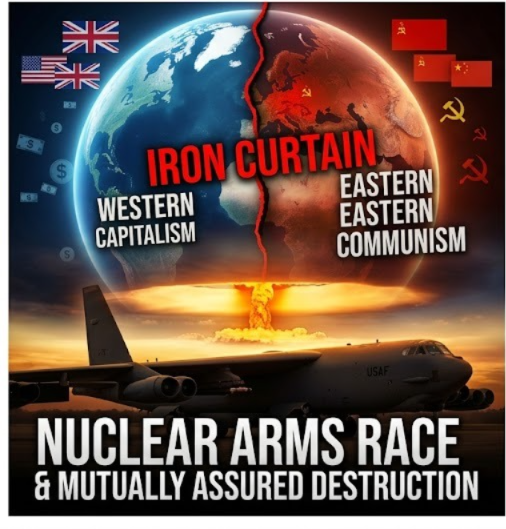
- Nuclear Arms Race: The development of atomic weapons increased fear and tension.
- Post-War Conflicts: Disagreements over rebuilding Europe fueled hostility.
These causes led to a long-standing rivalry that affected global politics for decades.
Major Events During the Cold War
The Cold War included several significant events that shaped world history:
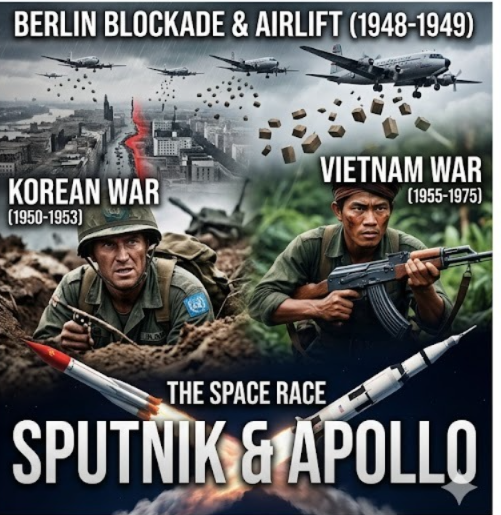
The Berlin Blockade (1948–1949)
The Soviet Union blocked access to West Berlin, prompting the United States to organize the Berlin Airlift to supply the city.
The Korean War (1950–1953)
A proxy war between North Korea (supported by the Soviet Union and China) and South Korea (backed by the United States).
The Cuban Missile Crisis (1962)
One of the most dangerous moments, when the world came close to nuclear war after the Soviet Union placed missiles in Cuba.
The Vietnam War (1955–1975)
Another proxy war where the United States attempted to prevent the spread of communism in Southeast Asia.
The Cold War Arms Race
One of the most defining aspects of the Cold War was the nuclear arms race. Both superpowers developed massive stockpiles of nuclear weapons, leading to a policy known as “Mutually Assured Destruction” (MAD). This meant that if one country launched a nuclear attack, the other would retaliate, resulting in total destruction for both sides.
This constant threat of nuclear war created fear worldwide and influenced global politics and defense strategies.
Impact of the Cold War
The Cold War had a major influence on international relations:
- Formation of military alliances like NATO and the Warsaw Pact
- Division of countries, especially Germany and Korea
- Rise of espionage and intelligence agencies
- Technological advancements, including the Space Race
It also influenced culture, education, and international diplomacy for decades.
End of the Cold War
The Cold War began to decline in the late 1980s due to economic problems in the Soviet Union and reforms introduced by its leadership. The fall of the Berlin Wall in 1989 represented the demise of communist dominance in Eastern Europe.
In 1991, the Soviet Union officially dissolved, marking the end of the Cold War and leaving the United States as the world’s only superpower.
The Cold War was a critical period in modern history that shaped international relations, military strategies, and global politics. Although it did not result in direct warfare between the United States and the Soviet Union, its effects were felt worldwide through proxy conflicts, nuclear tension, and political competition. Understanding the Cold War helps explain many of today’s global dynamics and conflicts.
Read Also : Social Network Website Design