Audio technology is moving beyond traditional left-and-right stereo toward listening experiences that feel more three-dimensional. Immersive spatial mixing allows creators to position sounds around a virtual listening environment, giving music, movies, podcasts, and games greater depth and realism. Dolby Atmos, for example, can be rendered for headphones through binaural processing, translating spatial information into a two-channel headphone experience.
This shift is changing how listeners think about headphones. Instead of simply delivering clear vocals and powerful bass, modern headphones increasingly aim to create a sense of space, distance, movement, and positioning.
What Is Immersive Spatial Mixing?
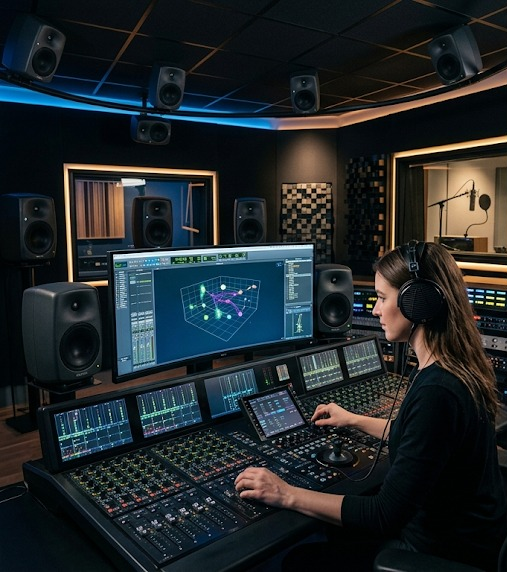
Immersive spatial mixing is an approach to audio production in which individual sounds can be placed within a three-dimensional environment. A producer can make a vocal appear directly in front of the listener while instruments occupy different positions around the virtual sound field.
Unlike conventional stereo mixing, which primarily works across a horizontal left-right image, spatial formats can introduce height and depth. This makes them particularly useful for films, gaming, virtual reality, live performances, and increasingly music streaming.
For headphone listeners, specialized binaural rendering recreates spatial cues using only the left and right earcups or earbuds. The result can make sounds seem to originate outside the head rather than directly inside each ear.
Head Tracking Makes Sound More Natural
One of the most interesting headphone audio trends is dynamic head tracking. With this technology, the virtual sound field can remain anchored while the listener moves their head.
For example, imagine a singer positioned directly in front of you. If you turn your head to the right, the vocal can remain positioned toward the original direction rather than moving with your headphones. This small detail can make spatial audio feel more like listening to speakers in a physical room.
Modern immersive formats are also incorporating metadata and rendering techniques designed to support both headphones and speakers, making spatial content more adaptable across different playback systems.
Personalization Is Becoming More Important
Not everyone hears spatial audio in exactly the same way. The shape of the ears, head, and listening environment can influence how directional cues are perceived. As a result, personalized audio processing is becoming an important area of headphone development.
Future headphones are likely to combine microphones, sensors, software processing, and personalized profiles to create more convincing sound placement. Machine learning is also being explored for advanced spatial-audio creation and processing, including techniques that can transform conventional stereo material into more immersive formats.
Spatial Audio for Music, Movies, and Gaming
The applications of immersive mixing extend across entertainment. In music, spatial mixes can separate instruments and vocals more clearly while creating a larger soundstage. In movies, environmental sounds can surround the viewer and add realism to cinematic scenes.
Gaming may benefit even more because accurate positioning can help players identify where footsteps, vehicles, or other events are occurring. Virtual and augmented reality also depend heavily on convincing spatial sound because audio needs to correspond naturally with the user’s virtual surroundings.
The Headphone Market Is Becoming More Intelligent
Today’s premium headphones are increasingly defined by software as much as hardware. Active noise cancellation, adaptive sound, spatial processing, head tracking, and personalized listening profiles are becoming part of a broader connected audio experience.
Industry developments also show growing interest in combining audio technology with new wearable devices. Bose, for instance, has discussed applying its audio technologies beyond conventional headphones, including XR glasses and other emerging devices.
Challenges Behind the Immersive Audio Trend
Despite its advantages, spatial audio is not automatically better than stereo. The quality of the original mix, rendering system, headphones, software, and content compatibility can all affect the final result. Poorly produced spatial mixes may sound unnatural, overly processed, or less focused than a carefully mastered stereo track.
This means the future of immersive audio will not simply depend on adding more processing. Successful systems need accurate spatial positioning, natural tonal balance, low latency, and reliable compatibility.
The Future of Headphone Audio
The future of headphone audio appears increasingly focused on immersion, personalization, intelligence, and realism. Spatial mixing is becoming more accessible, while head tracking and advanced rendering are helping headphones reproduce experiences traditionally associated with multi-speaker systems.
As creators become more comfortable producing immersive content and consumers gain access to compatible headphones and streaming services, spatial audio could become a standard part of everyday listening rather than a premium novelty. The biggest opportunity lies in making immersive sound feel effortless—allowing listeners to experience greater depth and realism without needing complicated equipment or technical knowledge.
Top 10 Best Oscar-Winning Movies of All Time
Top 10 Horror Movies on Netflix
Read Also: Video Websites design