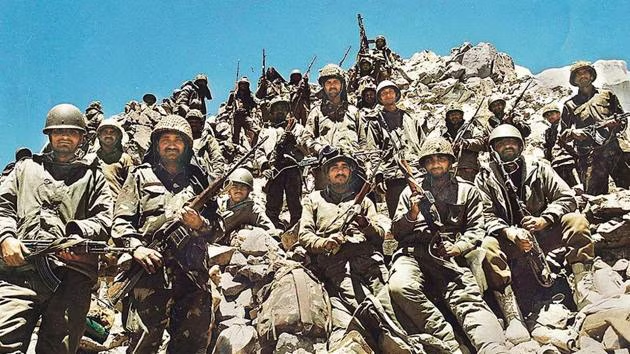
In the complex theater of South Asian geopolitics, certain military actions transcend tactical success to become symbols of national resolve. Operation Sindoor, launched on May 7, 2025, stands as a defining moment in India’s modern defense history. Initiated as a direct response to the tragic Pahalgam terror attack that claimed 26 lives, this operation redefined the “red lines” of Indian national security.
Unlike previous military engagements, Operation Sindoor was not just about fire and fury; it was a calibrated, tri-service masterclass in precision, jointness, and strategic communication.
The Catalyst-The Pahalgam Tragedy
On April 22, 2025, a brutal terror attack in Pahalgam sent shockwaves across the nation. The targeting of innocent civilians was a calculated attempt to incite communal discord. In the immediate aftermath, the Indian government shifted its policy from “strategic restraint” to “punitive compellence.” The message was clear: any attack on Indian soil would henceforth be treated as an act of full-scale war.
Strategic Objectives of Operation Sindoor
The operation was named “Sindoor”—a poignant tribute to the widows of the victims—emphasizing the human cost of terrorism. The primary objectives were:
- Infrastructure Dismantling: Targeted destruction of nine major terror camps across the Line of Control (LoC) and deep within enemy territory.
- Neutralizing Leadership: Eliminating the planners behind the Pahalgam incident.
- Deterrence by Denial: Demonstrating that Pakistan’s “nuclear blackmail” would no longer prevent India from executing conventional precision strikes.
The Tri-Service Execution-A Symphony of Force
Operation Sindoor showcased unprecedented synergy between the Indian Army, Navy, and Air Force. This was not a localized skirmish but a multi-domain campaign.
1. The Air Force-Precision from the Skies
The IAF utilized advanced SCALP cruise missiles and HAMMER precision-guided munitions launched from Rafale fighter jets. By targeting the Nur Khan and Rahimyar Khan airbases, the IAF effectively neutralized the adversary’s ability to launch a counter-air offensive, all while ensuring zero civilian collateral damage.
2. The Navy-Maritime Dominance
In a bold move, the Indian Navy deployed a Carrier Battle Group (CBG) to the Arabian Sea. This established a de facto maritime blockade, forcing enemy warships to retreat to commercial docks. The Navy’s presence acted as a “force for compellence,” signaling that India could choke the adversary’s economic lifelines at will.
3. The Army and BSF-Securing the Borders
While the strikes happened deep inside, the Indian Army and BSF maintained a “shield of steel” along the International Border. Significant infiltration attempts in the Samba sector were thwarted with lethal efficiency, ensuring the domestic front remained secure.

Non-Kinetic Warfare: Blood and Water
Operation Sindoor was unique because it integrated economic and diplomatic warfare with kinetic action. The most significant move was the suspension of the Indus Waters Treaty. Under the mantra “Blood and water cannot flow together,” India asserted its right to utilize the Western rivers, creating a massive strategic lever against an economy already on the brink of collapse.
Additionally, the closure of the Attari-Wagah border and the revocation of SAARC-related visas signaled a complete diplomatic decoupling until terror infrastructure is “credibly and irrevocably” dismantled.
The Global Impact and Legacy
The international community largely viewed Operation Sindoor as a justified act of self-defense. By using high-precision technology and maintaining “operational ethics,” India successfully avoided a full-scale nuclear escalation while achieving its military goals.
Operation Sindoor will be remembered not just for the targets it hit, but for the clarity it provided. It established that India possesses both the political will and the technological edge to protect its citizens. It marks the transition of India from a reactive state to a proactive regional power, ensuring that the cost of cross-border providence is higher than any adversary can afford to pay.
Read Also : Social Network Website Design