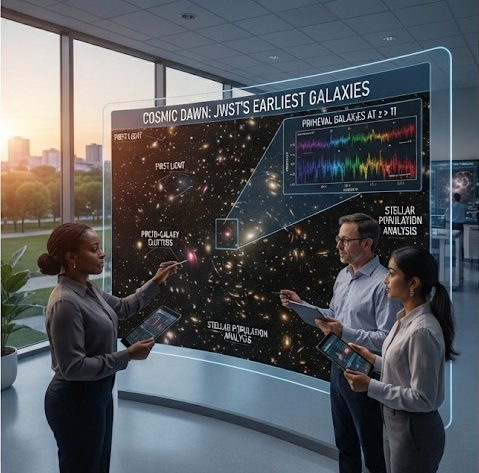
The James Webb Space Telescope (JWST) has transformed our understanding of the early universe by allowing astronomers to observe some of the oldest and most distant galaxies ever detected. Designed primarily for infrared astronomy, Webb can capture ancient light that has been stretched to longer wavelengths as the universe expands. These observations are helping scientists investigate one of astronomy’s biggest questions: how did the first galaxies form and evolve?
Seeing the Universe’s First Galaxies
Before Webb, astronomers had difficulty observing galaxies from the universe’s earliest periods because their light is extremely faint and strongly shifted into the infrared. JWST’s large mirror and infrared instruments have changed that situation. Its observations have revealed galaxies that existed only a few hundred million years after the Big Bang.
One major milestone came through the JWST Advanced Deep Extragalactic Survey (JADES). Spectroscopic observations confirmed several extremely distant galaxies, including objects dating to roughly 330 million years after the Big Bang. These discoveries provide scientists with direct evidence of galaxies during the universe’s infancy.
Galaxies Formed Faster Than Expected
One of the most interesting James Webb Telescope early galaxy formation discoveries is that some young galaxies appear surprisingly bright and active. Scientists expected the earliest galaxies to be relatively small and still developing, yet Webb has identified objects containing significant numbers of stars and showing strong evidence of rapid star formation.
NASA observations from the JADES program have found hundreds of galaxies that existed when the universe was less than 600 million years old. Some contained large populations of young, hot stars capable of producing enormous amounts of ultraviolet radiation.
These findings are encouraging astronomers to reconsider how quickly galaxies could gather gas, create stars, and develop more complex structures.
Discovering Early Galaxy Clusters
Webb has also provided evidence that galaxies did not evolve independently. In 2023, astronomers confirmed a group of seven galaxies located around 650 million years after the Big Bang. The galaxies were identified as members of a developing protocluster, offering an early glimpse of how large-scale cosmic structures began assembling.
Studying these early groups can help researchers understand how gravitational interactions caused small galaxies to gather into increasingly massive structures. Over billions of years, some of these systems eventually developed into the enormous galaxy clusters observed today.
Cold Gas and the Birth of Stars
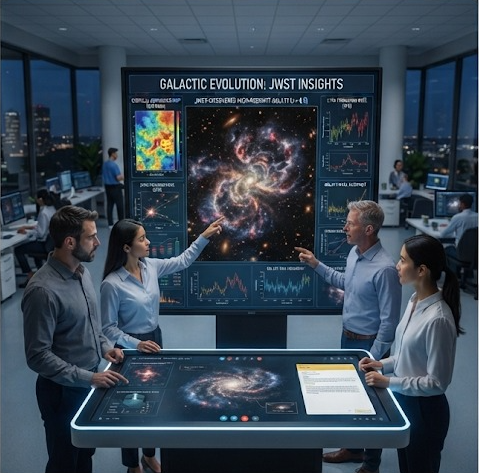
Another important discovery concerns the raw material required for galaxy formation. Webb observations have identified galaxies from roughly 400 to 600 million years after the Big Bang surrounded by large amounts of neutral hydrogen gas.
This gas is particularly important because hydrogen and helium were among the earliest elements in the universe. As gas accumulated inside young galaxies, it could cool, become denser, and eventually collapse to create new stars. Webb’s observations therefore provide valuable clues about the physical process connecting primordial gas with the first generations of stars.
Webb and the Era of Reionization
Early galaxies may also have played a major role in transforming the entire universe. During the Era of Reionization, much of the space between galaxies was filled with neutral hydrogen that blocked certain types of light.
Webb observations have shown that early galaxies produced enough energetic radiation to ionize surrounding hydrogen, creating expanding bubbles of transparent gas. Over time, these bubbles grew and merged, helping make the universe increasingly transparent.
A New Picture of Cosmic Dawn
The discoveries made by JWST are changing the scientific picture of early galaxy formation. Rather than developing slowly in isolation, some galaxies appear to have formed stars rapidly, interacted with neighboring systems, accumulated gas, and contributed to the transformation of their cosmic surroundings.
Webb has also opened new questions about the relationship between early galaxies, massive black holes, dark matter, and the growth of cosmic structures. NASA describes the telescope as a powerful tool for studying the period known as “Cosmic Dawn,” roughly the first billion years after the Big Bang.
The James Webb Telescope early galaxy formation discoveries are giving humanity an unprecedented view of the universe’s beginnings. By detecting ancient galaxies, studying their stars and gas, and revealing developing galaxy clusters, JWST is helping scientists reconstruct how the first major structures emerged. As Webb continues observing deeper into cosmic history, its findings could further reshape our understanding of how the universe evolved from a young, simple state into the complex cosmos we see today.
Discover the Best Telescopes for Amateur Astronomers
Read Also: Education Website Design