Low Earth Orbit (LEO) satellites are transforming the way people, businesses, governments, and scientific organizations connect across the planet. Positioned relatively close to Earth compared with traditional geostationary satellites, LEO systems can deliver faster communication, improved responsiveness, and broad geographic coverage. As satellite constellations continue to expand, global coverage of Low Earth Orbit satellites is becoming an important part of modern telecommunications and space technology.
What Are Low Earth Orbit Satellites?
Low Earth Orbit satellites generally operate at altitudes below 2,000 kilometers above Earth. Their relatively low position allows signals to travel shorter distances between satellites and ground terminals, which can reduce communication delays. Unlike geostationary satellites, LEO satellites move rapidly around the planet, meaning a single satellite cannot provide continuous coverage of one location.
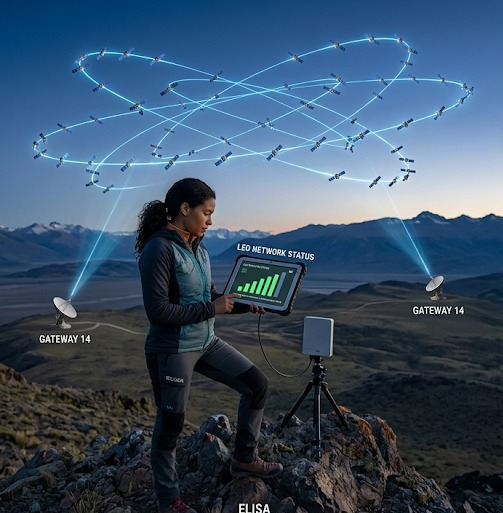
Instead, operators deploy groups of satellites known as LEO constellations. Multiple satellites work together so that as one moves out of range, another can take over the connection. This coordinated approach can create continuous or near-continuous service across large geographic areas.
How LEO Satellites Achieve Global Coverage
Global coverage depends on the number, altitude, inclination, and orbital arrangement of satellites. A carefully designed constellation places satellites across multiple orbital planes, allowing them to pass over different parts of Earth.
Polar and high-inclination orbits are particularly useful for reaching higher latitudes. As satellites continuously travel around Earth, their combined footprints can cover regions that terrestrial networks may struggle to reach. However, achieving truly continuous coverage requires sufficient satellite density and an appropriate orbital design.
Ground infrastructure is equally important. Gateways, antennas, data centers, fiber connections, and user terminals connect the satellites to terrestrial networks. The International Telecommunication Union notes that growing LEO constellations require extensive ground networks and careful coordination of radio spectrum.
Benefits of Worldwide LEO Satellite Coverage
One of the biggest advantages of LEO networks is their ability to provide connectivity in locations where conventional infrastructure is limited. Remote villages, ships, aircraft, rural communities, and isolated industrial facilities can potentially access satellite-based communication without depending entirely on local fiber or cellular towers.
LEO satellites can also support applications that benefit from lower latency. Broadband internet, cloud services, video communications, emergency communications, and certain real-time applications can benefit from the shorter signal path compared with higher-orbit satellite systems. Research has identified remote connectivity, emergency response, mobile communications, and government services as important applications for LEO constellations.

LEO Satellites and Earth Observation
Global LEO coverage is not limited to internet services. Earth-observation satellites operate in low orbit to monitor weather, climate conditions, oceans, agriculture, disasters, and environmental changes.
For example, NOAA’s Joint Polar Satellite System satellites travel from pole to pole and provide repeated global observations that support weather forecasting and climate research.
LEO platforms can also collect high-resolution information because of their proximity to Earth. This makes them valuable for mapping, environmental monitoring, infrastructure inspection, and disaster assessment.
Challenges of Global LEO Coverage
Despite their advantages, worldwide LEO coverage presents significant challenges. Operators must launch and maintain large numbers of satellites, coordinate frequencies, manage orbital traffic, and reduce the risk of space debris. Satellites also move quickly, requiring sophisticated systems to hand connections between spacecraft without disrupting service.
Regulation is another major consideration. Because satellites cross national borders, operators must comply with different national licensing requirements and international spectrum rules.
The Future of Global LEO Connectivity
The future of LEO satellite technology is likely to involve larger constellations, improved satellite-to-satellite links, smarter network management, and stronger integration with terrestrial 5G and future 6G systems. Major commercial networks are already demonstrating how LEO satellites can complement traditional communication infrastructure.
The global coverage of Low Earth Orbit satellites represents a major shift in satellite communications and Earth observation. By combining numerous fast-moving satellites with advanced ground infrastructure, LEO constellations can extend connectivity beyond the reach of traditional networks while supporting scientific and environmental applications. Although challenges involving cost, regulation, congestion, and orbital sustainability remain, continuing technological development could make LEO networks an increasingly important component of the world’s digital infrastructure.
Effects of AI in Upcoming Technology
Manhole – Essential Access Points in Urban Infrastructure
RCPC Manhole Covers and Frames
Read Also: Social Network Website Design