There is a shift in people’s perceptions of home. Rising housing costs, smaller households, remote work, and a growing desire for meaningful social connections are encouraging people to explore alternatives to traditional housing. Co-housing and shared living trends are becoming increasingly relevant as individuals look for homes that combine privacy with community.
Co-housing generally involves private homes supported by intentionally shared spaces and community facilities. Shared living can take several forms, including co-living apartments, house sharing, multigenerational homes, and communities where residents share kitchens, gardens, workspaces, or other facilities. Recent research highlights shared housing as a potential way to use residential resources more efficiently while maintaining access to functional communal spaces.
What Is Co-Housing?
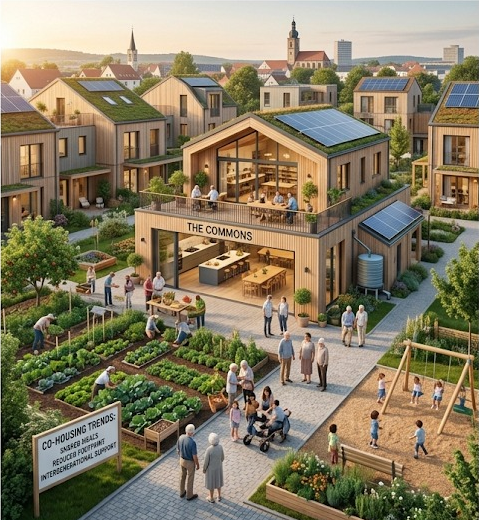
Co-housing is more than simply living with roommates. It is an intentionally designed residential model where people maintain private living areas while sharing selected spaces and resources. Common facilities may include gardens, dining rooms, lounges, workshops, playgrounds, or community kitchens.
The concept has evolved significantly since the 1970s and has become associated with intentional communities responding to social, environmental, and urban housing challenges.
The main attraction is balance. Residents can enjoy personal space while also having opportunities to interact with neighbors, share responsibilities, and participate in community activities.
Why Shared Living Is Becoming Popular
Affordability is one of the strongest factors behind the growth of shared living. In many cities, purchasing or renting a private home can place significant pressure on household budgets. Sharing selected facilities and expenses can make urban living more practical.
However, affordability is not the only motivation. Many people are also looking for stronger social connections. Modern lifestyles can sometimes lead to isolation, particularly for people living alone or moving frequently for work.
Shared living creates natural opportunities for interaction through communal meals, social events, gardens, and collaborative activities. This community-focused approach is increasingly being viewed as an important part of contemporary housing design.
Remote Work Is Influencing Co-Living

The growth of flexible and remote work is also changing shared housing. Residents may want reliable internet, quiet work areas, meeting rooms, and comfortable communal spaces within their residential environment.
Modern co-living properties are therefore moving beyond basic shared accommodation. Some are designed around a combination of living, working, networking, and socializing. This can be particularly attractive to young professionals, freelancers, entrepreneurs, and people who relocate regularly.
Sustainability and Resource Sharing
Sustainability is another important element of the co-housing movement. When residents share facilities, tools, transportation options, gardens, appliances, or other resources, fewer individual resources may be required.
Research into shared housing increasingly connects these arrangements with resource efficiency and lower consumption.
Well-planned communities can also encourage walking, cycling, shared meals, waste reduction, and environmentally responsible lifestyles.
Multigenerational Shared Living
Another emerging trend is multigenerational living, where different generations share a home or residential community. Families may combine resources while providing mutual support for childcare, household responsibilities, and older family members.
This approach can help address both housing costs and social isolation. Similar trends are appearing in different countries as households reconsider whether living independently is always the most practical option.
Technology and the Future of Shared Homes
Technology is likely to play a larger role in shared living. Digital platforms can help residents manage bookings for shared facilities, organize community events, communicate with neighbors, and coordinate household responsibilities.
Smart-home systems may also improve energy management, security, access control, and maintenance. As technology becomes more integrated into residential design, shared homes could become increasingly flexible and efficient.
Challenges of Co-Housing
Despite its advantages, co-housing is not suitable for everyone. Residents must be comfortable with shared responsibilities, community rules, and occasional compromises. Privacy, noise, decision-making, maintenance, and differing lifestyles can create challenges.
Affordability can also remain an issue because acquiring suitable land, designing communal facilities, and navigating planning regulations can make some co-housing projects expensive. Recent research emphasizes that supportive planning policies and clearer regulations may be necessary for shared housing to expand.
Co-housing and shared living trends reflect a broader transformation in how people approach home, community, affordability, and sustainability. Instead of viewing a home only as private space, more people are considering housing as an opportunity to share resources while maintaining personal independence.
As cities become more expensive and lifestyles continue to evolve, community-oriented housing models could become an increasingly important part of the residential landscape. The future of housing may not be entirely private or entirely communal—it may be a thoughtful combination of both.
RCPC Manhole Covers and Frames
RCPC Gully Grating and Gully Pit Cover
Read More: Interior Decoration Website Design