
In today’s competitive business environment, companies constantly look for ways to improve productivity, reduce operational costs, and deliver better customer experiences. One of the most effective strategies for achieving these goals is Business Process Management (BPM). BPM helps organizations streamline workflows, automate repetitive tasks, and enhance overall business performance.
Whether you run a small business or a large enterprise, understanding business process management can help you optimize operations and stay ahead of competitors. This article explains BPM, its benefits, key components, and why it is essential for modern businesses.
What is Business Process Management?
Business Process Management (BPM) is a systematic approach used to design, analyze, improve, and automate business processes. A business process refers to a sequence of tasks or activities performed to achieve a specific organizational goal.
BPM focuses on improving efficiency by identifying unnecessary steps, reducing errors, and ensuring smoother workflow management. It combines people, technology, and business strategies to create better operational performance.
For example, a company may use BPM software to automate invoice approvals, employee onboarding, customer support, or order processing.
Importance of Business Process Management
Business process management plays a crucial role in helping organizations operate more efficiently. Without a proper system, businesses often face delays, communication gaps, and increased operational costs.
Here are some major reasons why BPM is important:
- Improves operational efficiency
- Reduces manual errors
- Enhances customer satisfaction
- Increases productivity
- Simplifies complex workflows
- Supports better decision-making
- Helps businesses adapt to market changes
By implementing BPM strategies, companies can improve workflow transparency and maintain consistency across departments.
Key Components of BPM
1. Process Design
The first step in BPM is designing business processes. Organizations identify tasks, responsibilities, and workflow structures to ensure smooth execution.
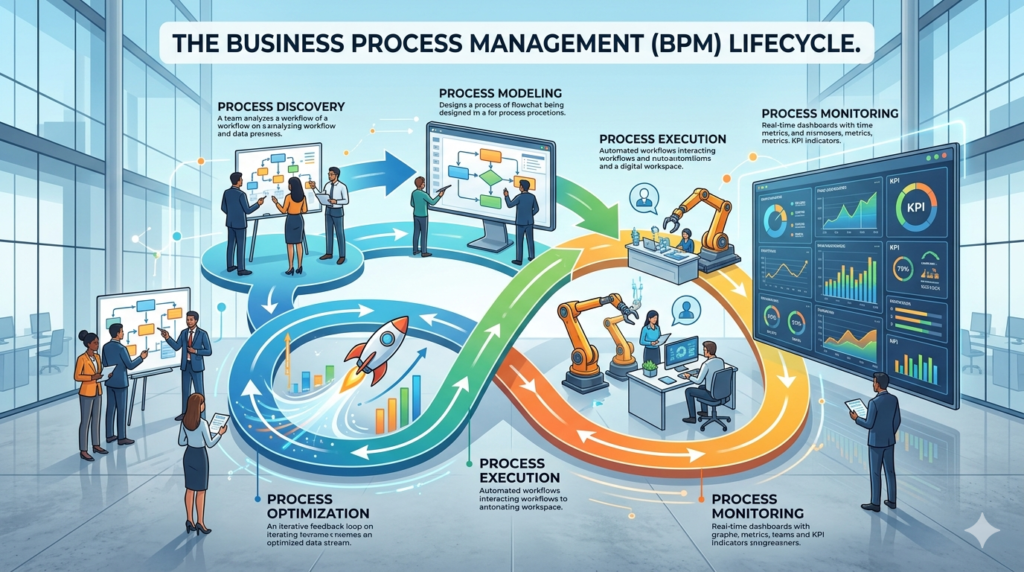
2. Process Modeling
Process modeling involves creating visual representations of workflows using flowcharts or diagrams. This helps businesses understand how operations function and where improvements are needed.
3. Process Automation
Automation is one of the most valuable aspects of BPM. Businesses use software tools to automate repetitive tasks, reducing human intervention and improving accuracy.
4. Process Monitoring
Monitoring helps track performance metrics and identify bottlenecks. Companies can measure productivity, turnaround time, and workflow efficiency.
5. Process Optimization
Optimization focuses on continuous improvement. Businesses regularly update processes to enhance efficiency and adapt to changing market demands.
Benefits of Business Process Management
Increased Productivity
BPM eliminates unnecessary tasks and improves workflow efficiency, allowing employees to focus on more strategic activities.
Better Customer Experience
Efficient processes lead to faster response times and improved service quality, resulting in higher customer satisfaction.
Reduced Costs
Automation and process optimization help minimize operational expenses and reduce resource wastage.
Improved Compliance
BPM ensures that processes follow industry regulations and company policies, reducing compliance risks.
Enhanced Collaboration
Clear workflows and communication channels improve teamwork and coordination between departments.
Business Process Management Tools
Many businesses use BPM software solutions to manage workflows effectively. Popular BPM tools include:
These platforms provide automation, workflow tracking, reporting, and collaboration features for businesses of all sizes.
Challenges in BPM Implementation
Although BPM offers many advantages, businesses may face certain challenges during implementation:
- Resistance to organizational change
- High initial setup costs
- Lack of employee training
- Integration issues with existing systems
- Difficulty in process standardization
Proper planning, employee involvement, and choosing the right BPM software can help overcome these challenges.
Future of Business Process Management
The future of business process management is closely connected with technologies such as Artificial Intelligence (AI), Machine Learning, and Robotic Process Automation (RPA). These innovations are making BPM systems smarter and more efficient.
Modern BPM solutions can now analyze data, predict workflow issues, and automate decision-making processes. As digital transformation continues, BPM will remain a critical tool for businesses aiming to improve agility and competitiveness.
Business Process Management is essential for organizations seeking long-term growth and operational excellence. By improving workflows, reducing costs, and increasing productivity, BPM helps businesses perform more efficiently in a fast-changing market.
Companies that invest in business process management can achieve better customer satisfaction, improved collaboration, and sustainable business success. As technology continues to evolve, BPM will become even more important for businesses looking to stay competitive and innovative.
Freelancerson.com a Free Marketplace for Freelancers and Clients
Read Also: Job Seeker Website Portal