The retail industry is changing rapidly as businesses and consumers become more aware of waste, resource consumption, and environmental responsibility. Traditional retail often follows a linear “take, make, sell, and dispose” system. In contrast, circular economy models in retail aim to keep products, materials, and resources in use for as long as possible. This approach can reduce waste while creating new opportunities for retailers to improve customer relationships, develop additional revenue streams, and strengthen long-term business resilience.
What Is a Circular Economy in Retail?
A circular economy in retail is a business approach designed to extend product lifecycles and minimize unnecessary resource consumption. Instead of treating products as disposable after their first use, retailers can create systems for repair, resale, rental, refurbishment, reuse, and responsible recovery.
The Ellen MacArthur Foundation identifies rental, resale, repair, and remaking as important circular business models, particularly in fashion.
This model changes the role of retailers from simply selling new products to managing the value of products throughout their lifecycle.
Resale and Second-Hand Retail
Resale is one of the most visible circular economy models in retail. Retailers can collect pre-owned products from customers, inspect them, restore them when necessary, and sell them again.
Fashion, electronics, furniture, and sporting goods are particularly suitable for resale programs. Brand-owned resale platforms can also help retailers maintain customer engagement after the original purchase.
For consumers, resale can provide access to quality products at lower prices. For retailers, it can create another source of revenue while keeping products in circulation for longer.
Repair and Refurbishment Services
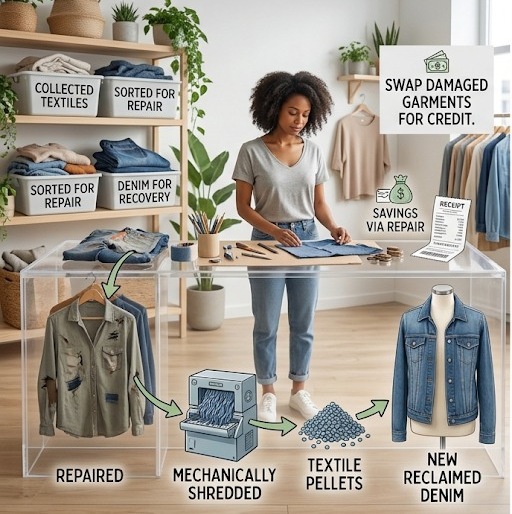
Repair is another important part of circular retail. Instead of encouraging customers to replace damaged products, retailers can provide repair, maintenance, alteration, or refurbishment services.
For example, clothing retailers can offer stitching and alteration services, while electronics businesses can provide device repairs and component replacements. Repair programs can increase product longevity and strengthen customer loyalty.
Recent retail trends show brands increasingly experimenting with repair services and workshops as part of their sustainability strategies.
Rental and Product-as-a-Service Models
Rental allows customers to access products without permanently owning them. This model can work particularly well for clothing, furniture, tools, electronics, and specialty equipment.
A product-as-a-service approach goes a step further by selling access or performance rather than ownership. Customers may pay through subscriptions, leasing arrangements, or usage-based fees.
This can encourage businesses to design products that last longer because the company remains connected to the product throughout its useful life.
Reuse and Refill Systems
Retailers can also reduce packaging waste through reusable containers and refill stations. Instead of purchasing a new package every time, customers refill an existing container.
Grocery, personal-care, household, and food retailers can use refill systems to reduce dependence on single-use packaging. Digital loyalty programs can further encourage customers to participate by offering rewards for repeated refills.
Take-Back and Reverse Logistics
A successful circular retail strategy needs an efficient reverse logistics system. Retailers can provide convenient collection points where customers return unwanted, damaged, or outdated products.
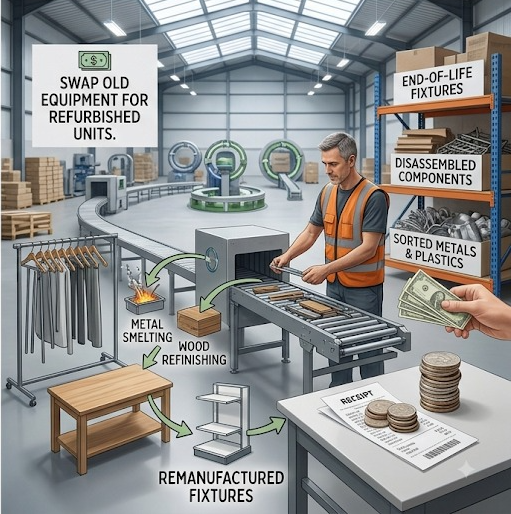
Returned items can then be sorted into different pathways: resale, repair, refurbishment, remanufacturing, reuse, or recycling. This creates a system where products move back into productive use instead of immediately becoming waste.
Benefits for Retail Businesses
Circular economy models can provide several business advantages. Retailers may develop new revenue streams through resale, rental, repair, and subscription services. They can also improve customer loyalty by offering services beyond the initial sale.
Circular models can additionally reduce dependence on virgin materials and support more resilient supply chains. However, retailers need to evaluate transportation, processing, labor, and energy requirements carefully because not every circular initiative automatically produces the same environmental benefit.
The Future of Circular Retail
The future of retail is likely to involve a combination of traditional sales and circular services. Retailers can design durable products, offer repair options, establish resale channels, introduce take-back programs, and use technology to track products throughout their lifecycle.
Ultimately, circular economy models in retail are about changing how value is created. Instead of relying exclusively on selling more new products, businesses can generate value by keeping existing products useful for longer. With thoughtful design, efficient logistics, customer participation, and transparent sustainability practices, circular retail can become an important part of a more resource-efficient economy.
Trends, opportunities and challenges of farm mechanization in India
Success stories and lessons from India’s agricultural cooperatives
Read Also: Laravel Framework Web Development