Pablo Picasso remains one of the most influential artists in history, known for reshaping modern art through bold creativity and relentless innovation. His life story is a remarkable journey filled with passion, experimentation, and artistic evolution. From his childhood in Spain to his legendary status in France, Picasso’s story continues to inspire millions around the world.
Early Life and Artistic Beginnings
Málaga, Spain, is where Pablo Picasso was born on October 25, 1881. His father, José Ruiz Blasco, was an art teacher and painter, which exposed Picasso to creativity from a very young age. It quickly became clear that Picasso possessed extraordinary talent—far beyond his years.
At just seven years old, he began formal art training under his father’s guidance. By the age of thirteen, Picasso’s skills impressed many, and his father even handed over his own paintbrushes, acknowledging his son’s superior talent. Picasso later enrolled in the School of Fine Arts in Barcelona, where he continued mastering traditional techniques.
The Blue and Rose Periods
In 1901, after moving to Paris, Picasso entered what became known as his Blue Period. This phase was marked by paintings in shades of blue and green, expressing themes of loneliness, poverty, and emotional struggle. Works like The Old Guitarist became symbolic of this deeply introspective time.
Around 1904, Picasso transitioned into the Rose Period, featuring warmer colors like pink and red. His subjects shifted to circus performers, acrobats, and clowns. This period reflected newfound hope and emotional warmth, marking an important turning point in his artistic evolution.
Cubism: A Revolutionary Art Movement
One of Picasso’s most significant contributions to modern art was the creation of Cubism, alongside French artist Georges Braque. Beginning around 1907, this movement broke away from traditional perspectives, instead using geometric shapes and fragmented forms to represent reality.
Picasso’s groundbreaking painting “Les Demoiselles d’Avignon” introduced Cubism’s radical style to the world. Through Cubism, Picasso challenged the concept of visual representation and encouraged viewers to see objects from multiple angles at the same time. This artistic innovation changed the direction of 20th-century art forever.
Exploring Multiple Art Styles
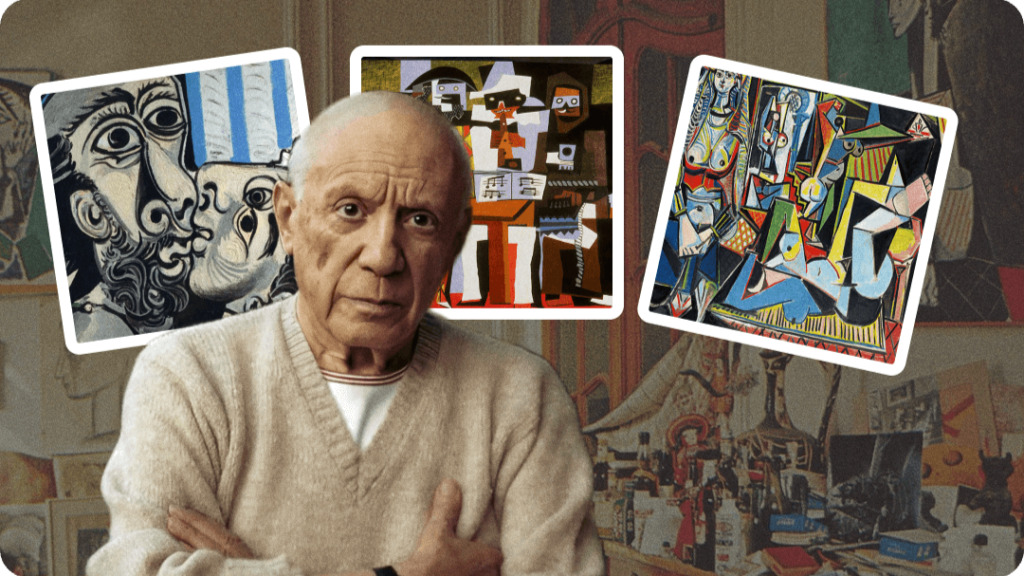
Picasso never confined himself to one technique or style. His creativity spanned over 80 years, during which he produced paintings, sculptures, ceramics, drawings, prints, and even stage designs. His ability to constantly reinvent his artistic voice made him one of the most versatile creators in history.
Throughout his long career, Picasso moved through various styles including Classicism, Surrealism, and Expressionism. His openness to experimentation kept his work fresh, exciting, and influential across generations.
Guernica: A Powerful Anti-War Message
In 1937, Picasso created one of his most iconic masterpieces—Guernica. This massive painting was a response to the bombing of the town of Guernica during the Spanish Civil War. With sharp lines, distorted figures, and strong emotional intensity, Picasso captured the horrors of war and the suffering of innocent people.
Guernica quickly became a global symbol of peace and a powerful political statement. It remains one of the most celebrated anti-war artworks ever created.
Later Years and Legacy
Picasso spent his later years in the south of France, continuing to create art until the end of his life. He passed away on April 8, 1973, leaving behind an extraordinary legacy that includes more than 20,000 works.
His influence on modern art is unmatched. Picasso’s innovative spirit, bold imagination, and constant desire to break boundaries make him a timeless figure in the world of art.
The life story of Pablo Picasso is a tale of unmatched creativity and artistic courage. From his early training in Spain to his revolutionary impact on global art, Picasso’s journey reminds us that true genius lies in daring to see the world differently. His legacy continues to inspire artists, thinkers, and admirers across the globe.
Sherlock Holmes by Sir Arthur Conan Doyle
Byomkesh Bakshi by Sharadindu Bandyopadhyay
Aranyak by Bibhutibhushan Bandopadhyay
Read Also: Education Website Design